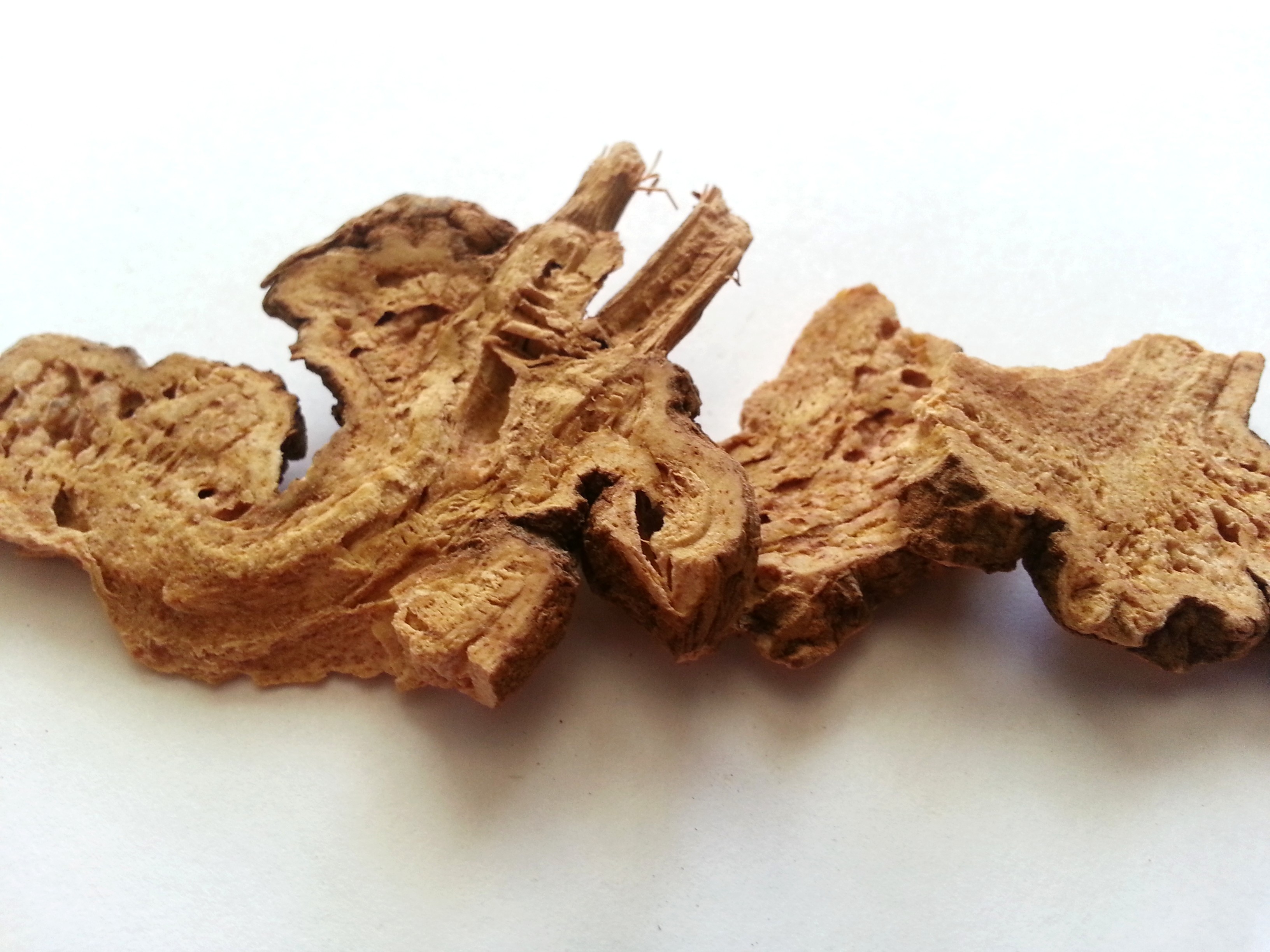
Bai Zhu
Atractylodis macrocephalae Rhizoma
bitter, sweet, warm
PRIMARY FUNCTION:
Tonify Qi
CLASSICAL MANIFESATIONS:
- Disorders of the Gastrointestinal tract
- Diarrhea
- Reduced appetite
- Indigestion
- Poor functions of the spleen and stomach
- Fatigue
- Pale complexion
- Blood deficiency
- Edema
- Reduced urination
- Muscle pain
- Spontaneous sweating
- Threatened miscarriage
Bai Zhu is bitter, sweet, and warm. In enters the spleen and stomach systems to nourish and improve digestive function. It is a very important herb for digestion and health related to assimilation and elimination disorders.
Digestion requires hydrochloric acid in the stomach to liquefy the bolus of food into a substance called chyme. This process must be complete before the pyloric sphincter can open to let the digested food into the duodenum where the pancreas adds enzymes and the gallbladder adds bile. Enzymes continue to refine the digestion of food material and bile emulsifies fat. Bai Zhu helps to improve this entire process of digestion so that proper filtration, assimilation, and elimination can take place in the rest of the lower gastrointestinal tract.
Keep in mind that when there is poor stomach function, the pancreas compensates with extra secretions of enzymes. Since the pancreas is both an exocrine (enzymes) and an endocrine (hormones) gland the ability to manage blood sugars is compromised (insulin and glucagon come from the pancreas). This explains why many patients that present with dysglycemia also present with gastrointestinal complaints and vice versa.
Channels: spleen, stomach
COMMON APPLICATIONS AND CLINICAL POSSIBILITIES:
- Obesity
- Dysglycemia
- Insulin resistance
- Hyperinsulinemia
- Fatigue
- Dysglycemia
- Hypothyroid
- Pancreatic secretions
- Endocrine dysregulation
- Insulin
- Glucagon
- Exocrine dysregulation
- Enzymes
- Hypochlorhydria
- Disorders of the gastrointestinal tract
- IBS
- Crohn’s disease
- Ulcerative colitis
- Gastritis
- Diarrhea
- Stomachache
- Acid reflux
- Hypothyroid
- Dysglycemia
- Jaundice
- Diuresis
Formulas:
- An Chong Tang
- An Tai Yin
- Ba Zhen Tang
- Bai Zhu Shao Yao San
- Ban Xia Bai Zhu Tian Ma Tang
- Bu Shen Gu Chong Wan
- Bu Zhong Yi Qi Tang
- Da Qin Jiao Tang
- Dan Zhi Xiao Yao San
- Dang Gui Nian Tong Tang
- Fang Feng Tong Sheng San
- Fu Ling Gui Zhi Gan Cao Da Zao Tang
- Fu Zi Li Zhong Wan
- Fu Zi Tang
- Gan Cao Gan Jiang Fu Ling Bai Zhu Tang
- Ge Hua Jie Cheng San
- Gu Ben Zhi Beng Tang
- Gu Chong Tang
- Gui Pi Tang
- Gui Zhi Ren Shen Tang
- Gui Zhi Shao Yao Zhi Mu Tang
- Hei Xiao Yao San
- Huang Tu Tang
- Huo Xiang Zheng Qi San
- Jia Wei Xiao Yao San
- Jian Pi Tang
- Ju Yuan Jian
- Kai Yu Zhong An Hui Tang
- Li Zhong Wan
- Ling Gui Zhu Gan Tang
- Liu Jun Zi Tang
- Mu Xiang Liu Qi Yin
- Ping Gan Kai Yu Zhi Xue Tang
- Ren Shen Yang Rong Tang
- Shen Ling Bai Zhu San
- Shi Pi Yin
- Shi Quan Da Bu Tang
- Si Jun Zi Tang
- Su He Xiang Wan
- Tai Shan Pan Shi San
- Tong Xie Yao Feng
- Wan Dai Tang
- Wei Ling Tang
- Wu Ling San
- Xiang Sha Liu Jun Zi Tang
- Xiang Sha Yang Wei Tang
- Xiao Yao San
- Yi Gan San
- Yi Gong San
- Yu Ping Feng San
- Zhen Ren Yang Zan Tang
- Zhen Wu Tang
- Zhi Shi Dao Zhi Wan
- Zhi Shi Xiao Pi Wan
- Zhi Zhu Wan
Contraindications: do not prescribe Bai Zhu to patients with deficiency heat patterns
Zoo Image: a husband and sweaty pregnant wife ferret visit a medieval torture exhibit, he sweats onto her umbrella while her baby’s feet poke out of her belly, and they see a ferret undergoing water torture and a spleen being forced to eat ice cubes