III. MATERIALS AND METHODS
Literature Search Strategy
Four electronic databases were used for literature selection: the Cochrane Central Register of Controlled Trials, PubMed, Alt Health Watch, and EBSCO. A comprehensive search of databases was executed using the keywords “irritable bowel syndrome and acupuncture,” “irritable bowel syndrome and moxibustion,” “visceral hypersensitivity and acupuncture,” and “visceral hypersensitivity and moxibustion.”
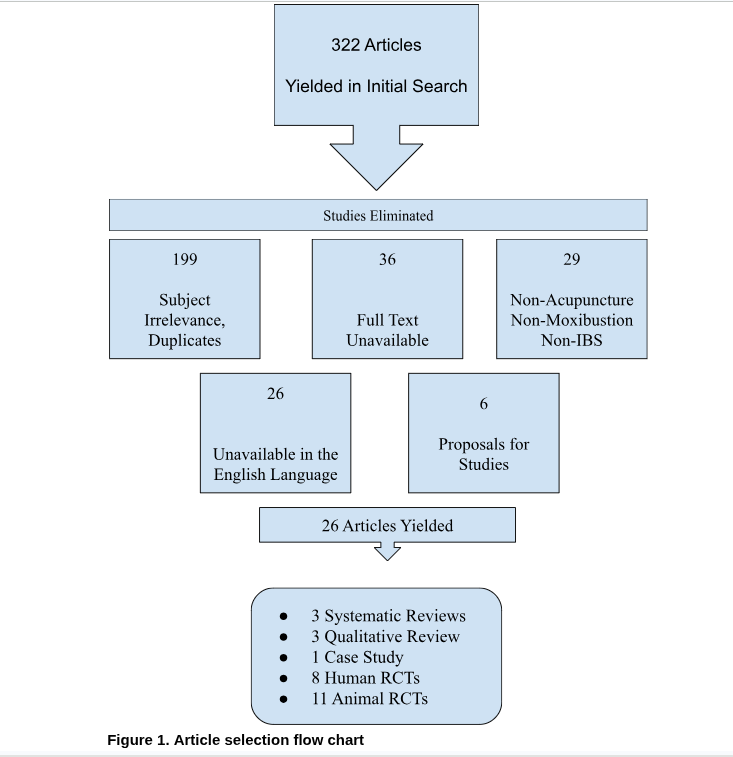
The initial search yielded 322 total articles. Many articles that came up in the search had no relevance to acupuncture or moxibustion. From an initial scan on articles and abstracts, 201 were eliminated based on subject relevance. Duplicates were also eliminated. Of the remaining 125 articles, 36 we unavailable in full text. 29 other article were eliminated because they did not involve acupuncture or moxibustion or IBS. Of the remaining 60 articles, 26 were not available in English. Of the remaining 34 articles, 6 were only proposals for future RCTs and did not include study results. A final total of 26 articles were identified and chosen for this review. Of the 26 articles yielded, there were 3 systematic reviews, 3 qualitative reviews, 1 case study, 11 RCTs using animal subjects, and 8 RCTs human subjects. See figure 1 for a summary of the selection process.
Inclusion Criteria
The types of studies that were allowed in the search process included RCTs, uncontrolled clinical trials, prospective case studies, systematic/meta-analysis reviews, literature reviews, and qualitative studies. Only English language studies were included. There was no discernment made between manual acupuncture, electroacupuncture, direct moxibustion, and indirect moxibustion. In summary, the inclusion criteria were studies performed between January 2012 and December 2017, studies reported in full text English articles that were peer reviewed and studies involving subjects that were treated with acupuncture or moxibustion for IBS related symptoms.
Exclusion Criteria
Studies more than 5 years old were excluded. Opinion based articles, including blog entries, and all non-scientific or non-peer reviewed articles were excluded. Studies without full text availability were excluded. Studies involving laser acupuncture, acupressure, auricular acupuncture, ear seeds, or reflexology were excluded. In summary, the exclusion criteria were studies older than five years, studies not in the English language, laser acupuncture, ear seeds, reflexology, and acupressure. Studies involving other ailments of the gastrointestinal tract were also excluded if they did not included IBS symptomatology.
Study Evaluations
The study design is a narrative review. Based on the exclusion and inclusion criteria, full texts of eligible studies were obtained from one of the four aforementioned databases and reviewed. They were categorized based on their study types: RCTs, systematic reviews/meta-analyses, case studies, and qualitative studies. The data from the studies were extracted and compared. The following items were extracted: author(s), study design, number of subjects, publication year, outcome measurements, and major results.
Randomized Controlled Trials (Human Subjects)
Clinical Study #1
MacPherson et al. (2016)performed a randomized controlled trial to study the use of acupuncture in the treatment of irritable bowel syndrome at 12 months post-randomization. The aim of the study was to evaluate the effects of acupuncture with patients in primary care with ongoing irritable bowel syndrome. Patients were randomized to an acupuncture group (n=116) that received usual care plus weekly acupuncture treatments for 10 weeks or to a group (n=117) that only received usual care (drug medications). Outcomes were based on a self-reporting scale using the IBS Symptom Severity Score measured at 24 months post randomization. The overall response rate was 61%. The study concluded that there were no statistically significant differences between the acupuncture group and the usual care group at 24 months (p<0.05).
Clinical Study #2
Zhenzhong (2015) conducted a random controlled trial with eighty-five IBS patients randomly divided into electro-acupuncture (EA) and moxibustion (moxa) groups to compare the impacts of EA and moxa on primary gastrointestinal symptoms and the expressions of colonic mucosa-associated neuropeptides substance P (SP) and vasoactive intestinal peptide (VIP). Patients included had either diarrhea-predominant or constipation-predominant irritable bowel syndrome (IBS-D and IBS-C, respectively). ST36 and ST37 were selected as acupoints for electroacupuncture or warm moxibustion treatment once a day for 14 consecutive days. Before and after the treatment sessions, a Visual Analog Pain Scale and the Bristol Stool Form Scale were implemented to evaluate gastrointestinal status. There were 41 participants with IBS-D and 40 with IBS-C that volunteered to receive colonoscopy exams before and after the treatments. During colonoscopy, collections from the sigmoid mucosa were taken to detect SP and VIP expression using immunohistochemistry assay. Both EA and moxa treatments were found to be effective at relieving abdominal pain in IBS-D and IBS-C patients. Moxa was more effective at reducing diarrhea in IBS-D patients, whereas EA was more effective at improving constipation in IBS-C patients. EA and moxa treatments both down-regulated the abnormally increased SP and VIP expression in the colonic mucosa, with no significant difference shown between the two treatments.
Clinical Study #3
Zheng (2016) conducted a randomized and parallel group controlled trial. A total of 448 participants were randomly allocated to 3 electroacupuncture groups and 1 loperamide group in a 1:1:1:1 ratio. These participants recorded weekly diarrhea diaries in a 10-week research period that is composed of a 2-week baseline phase, a 4- week treatment phase, and a 4-week follow-up phase. The diarrhea diaries included such input as stool frequency, stool consistency, normal defecations, and whether special food or drugs for diarrhea were taken. Before being randomized, the participants received baseline evaluations. The participants received 16 sessions of electroacupuncture or oral administration of loperamide daily during the 4-week treatment. Then, the participants were followed up for 4 weeks after treatment. The Bristol score decreased to 5.2 units at the week 4, with an improvement of 0.9 units compared with baseline. The 4 groups were comparable in scores using the Bristol Stool Scale assessed at week 4 and week 8. The study result showed that electroacupuncture was equivalent to loperamide in reducing stool frequency in patients with IBS-D or FD. Additionally, electroacupuncture improved stool consistency, the number of days with normal defecation, and quality of life.
Clinical Study #4
Anatasi (2017) conducted a randomized controlled trial using both moxibustion and acupuncture for the treatment of IBS. The study was a 24-week three-arm, prospective, parallel groups controlled trial of 171 men and women diagnosed with IBS-D based on Rome III diagnostic criteria for functional gastrointestinal tract disorders. The patients were randomly divided into one of three groups: standard care, individualized care, and sham care. Outcome measurements were based on the reduction of pain and secondary IBS symptoms (e.g bloating, gas, and stool consistency). Subjects were instructed to record their stool patterns using daily journals and took a weekly clinical global impression scale test. The authors of the study attempted to conform to the elements of scientific rigor while maintaining alignment with the foundations of acupuncture and oriental medicine. This study was particularly insightful in contributing eight diagnostic patterns and point prescriptions to cover the spectrum of IBS presentations: spleen and stomach qi deficiency, spleen qi deficiency with damp, spleen yang deficiency, kidney yang deficiency, liver qi stagnation, retention of cold damp, retention of damp heat, and retention of food.
Clinical Study #5
Shi (2015) conducted a randomized parallel controlled study on the effects of electroacupuncture vs the effects of moxibustion therapy for the treatment of irritable bowel syndrome. Eighty two adult IBS patients, ages 18-65 years old, were randomly allocated into two groups (n=41). One group was designated for treatment with moxibustion and the other group was designated for treatment with electroacupuncture. All patients were recruited from the Department of Gastroenterology in Jinhua Municipal Central Hospital between January 2012 and September 2013. Eligibility criteria included patients that displayed symptoms consistent with IBS based on Rome III diagnostic criteria. Baseline and outcome assessments were established based on the Visual Analogue Scale for Irritable Bowel Syndrome (VAS-IBS) to gauge both gastrointestinal symptoms and general well-being. Gastric serotonin secretions were measured using samples from the sigmoid colon. The patients received daily treatments for four consecutive weeks (excluding Sundays). ST25 and ST37 were used bilaterally. A Model LH 100A TENS unit was used to treat the electroacupuncture patients with a stimulation frequency of 2 Hz and intensity of 3.0 mA for 30 minutes. The patients receiving moxibustion were treated for 30 minutes with moxa 2-3 cm above the acupoints with a surface temperature of 46 ℃. The results showed a remarkable decline in VAS-IBS total scores in both the EA and moxibustion groups; however, there was no statistical significant difference between the two groups.
Clinical Study #6
A randomized double blind clinical trial was performed in 2014 by Rafiei, Ataie, Ramezani, Etemadi, and Nikyar. 60 patients, between 19 and 61 years in age, that were diagnosed with IBS based on the Rome III diagnostic criteria, were assigned to three groups. 51 were female and 9 were male. Pregnancy, diabetes, autoimmune disorders, and infections of the GI tract were conditions that were excluded in participants. First group received drug therapy, the second group received acupuncture, and the third group received sham acupuncture. The trial started with a 2 week evaluation period before being assigned to the three separate groups. For the acupuncture group, catgut technique was used and applied to UB17, 23, 25, DU3, SP9, 15, ST25, 36, REN12, 4, and KID15. Catgut is a type of cord that is made from the natural fibers of sheep or goat intestine. It is embedded in the acupuncture points to enhance the stimulation for 7-14 days. Catgut implantation is one kind of acupuncture where specific acupuncture points are continuously stimulated. Subjective questionnaires were used to evaluate symptoms, pain, depression and anxiety. The Statistical Package for Social Sciences, version 20, was used to analyze the data. The results showed a significant improvement with the acupuncture group in pain and depression.
Clinical Study #7
A randomized controlled trial was performed by Zhu, Wu, Ma, and Liu in 2014 using moxibustion to relief abdominal pain in patients suffering irritable bowel syndrome. Eighty IBS patients were randomly divided into a moxibustion group and a sham moxibustion group for treatment lasting 4 weeks. Volunteers, 15 patients in the moxibustion group and 13 patients in the sham group, completed two MRI scans during a 50 and 100 ml rectal balloon distention before and after treatment. Rectal pain was assessed with a scan test. The Birmingham IBS Symptom Scale and IBS Quality of Life Scale were used to evaluate the effects of treatment. ST25, REN6, and REN12 were the acupoints chosen for the application of the moxibustion treatment that was applied with an aconite barrier that was 2.5 cm diameter. Treatments were applied 3 times per week for duration of 2 weeks. The results showed a statistically significant decrease in symptoms in the moxibustion group. The moxa group also showed improvements in the prefrontal cortex, while the prefrontal cortex and the anterior cingulated cortex were affected in the control group. During the 100 ml distention before treatments in both groups, the prefrontal cortex and the anterior cingulated cortex were provoked. After treatment, the effect reduced in the moxibustion group but remained in the sham group. The research group concluded that moxibustion can improve the symptoms and quality of life in patients suffering IBS by decreasing rectal sensitivity.
Clinical Study #8
In 2014, Zhao, Wu, and Liu performed a factorial study to examine the effects of aconite-separated moxibustion. A total of 166 IBS patients, between the ages of 18 and 65 years ago, were randomly separated into four treatment groups with different applications of moxibustion treatment. Patients were diagnosed with IBS based on Rome III diagnostic criteria. Each patient received treatment 3 days a week for the duration of 2 weeks. For each group, the scores on the Birmingham irritable bowel syndrome questionnaire, the IBS Quality of Life Scale, the Self Rating Depression Scale, the Self Rating Anxiety Scale, the Hamilton Depression Scale, and the Hamilton Anxiety Scale were measured before, during, and after treatment. Moxibustion was applied to ST25 (bilaterally) and REN6. Patients from the aconite-separated moxibustion group showed significantly lower scores after the first and second treatments. The study concluded that aconite-separated moxibustion therapy applied three times per week with one cone per application was an effective treatment for patients with IBS.
Randomized Controlled Trials (Animal Subjects)
Clinical Study #1
Han (2014) conducted a randomized controlled trial using moxibustion therapy on rats. Thirty-two Sprague-Dawley rats were randomly assigned to a blank control group (normal rats, n = 6) and a model replication (MR) group (UC rats, n = 26). A UC model was established through colonic irritation by using 2,4,6-trinitrobenzenesulfonic acid/dextran sulfate sodium enemas. Rats in the MR group were further randomly assigned to a 9-min moxibustion therapy (9M) group (9 moxa-cone, n = 6), 6-min moxibustion (6M) group (6 moxa-cone, n = 6), 3-min moxibustion (3M) group (3 moxa-cone, n = 6), and a waiting list control (WLC) group (no moxibustion treatment, n = 6). Rats in the moxibustion treatment group received 14 treatments over the course of 28 days. Moxa treatment was applied to SP15 and ST25 bilaterally. UC rats received moxibustion treatment for 3 min (3M group), 6 min (6M group), and 9 min (9M group). Three, six, and nine moxa cones were used for each treatment in the 3M, 6M and 9M groups. Colon tissue was extracted and analyzed for disease activity, colon tissue morphology, blood levels of interleukin (IL)-8 and IL-10, and the expression of Toll-like receptor (TLR)9 as well as nuclear factor (NF)-κB p65 which was assessed through disease activity index (DAI), hematoxylin and eosin staining, electron microscopy, enzyme-linked immunosorbent assay, and Western blotting. Results showed a significant reduction in DAI which indicates that moxibustion is effective in improving the disease activity of UC rats. The moxibustion treatments showed improvements in several health factors including body mass, fecal viscosity, and rectal bleeding. The comparison of DAI among moxibustion treated groups showed that the 9 min treatment gave the best improvement of disease activity.
Clinical Study #2
Zhao (2018) conducted an animal study to compare the analgesic effects between electroacupuncture (EA) and moxibustion with visceral hypersensitivity in rats with irritable bowel syndrome. Fifty 250-300 gram male rats with irritable bowel syndrome were randomly divided into four groups of ten (n=10) which received varied intensity of electrical stimulation and moxibustion heat, with a fifth untreated group that was monitored as a control group. Treatments were applied to ST37 for 10 minutes everyday for seven consecutive days. The EA stimulation frequency of 2.0 Hz was used with intensities of 1.0 mA and 3.0 mA. The moxibustion was applied at 43℃ and 46℃ 22mm away from the skin. Colorectal irrigation was used to induce visceral hypersensitivity and abdominal withdrawal reflex scores were taken before and after the treatments. Mast cells were taken from the intestinal mucosa and Toluidine blue staining was applied to the sample which were evaluated under a light microscope for changes. Immunohistochemical assays of intestinal mucosa was examined for expressions of 5-HT, 5-HT3R, and 5-HT4R. The results illustrated that EA and moxibustion each had greater increased stimulation effects of wide dynamic neurons in the dorsal horn of the spinal cord in model rats with visceral hypersensitivity compared to the control group. However, moxibustion treatments were found to be superior over the EA treatments. Colonic tissue mast cell degranulation rates also show significant increases in the moxibustion and EA groups compared to the control group. According to this study, the dorsal horn of the spinal cord is very important in regulating of visceral hypersensitivity and should be a therapeutic target for IBS patients. This study shows that moxibustion and EA have the potential to inhibit the response of the neurons in the dorsal horn of the spinal cord activated by visceral nociceptive afferent impulses.
Clinical Study #3
Liu (2015) conducted an animal study to measure the effects of electroacupuncture on corticotropin-releasing hormone in rats with visceral hypersensitivity. Thirty male Sprague-Dawley rats were used in the study. The rats were subjected to colorectal balloon dilation for seven weeks to induce visceral hypersensitivity. Abdominal withdrawal reflex scores were measured to assess degree of irritation as well as behavioral responses. After the initial induction of bowel irritation the rats were divided into three groups; a model group, an electroacupuncture group, and a sham acupuncture group. ST37 was used in the electroacupuncture group for its traditional therapeutic effect on the colon. Expression of CRH protein and mRNA in the colon, spinal cord, and hypothalamus were extracted and examined using immunohistochemistry (EnVision method), ELISA, and fluorescence quantitative PCR methods. Electroacupuncture was reported to significantly reduce the visceral hypersensitivity in rats and also positively modulated the expression of CRH protein and mRNA. The authors concluded that EA has the potential to play a major role in the treatment of irritable bowel syndrome.
Clinical Study #4
Weng (2015) performed an animal study to evaluate the effect of acupuncture on the purinergic receptor P2X in the peripheral nervous systems to treat the visceral pain of irritable bowel syndrome. 24 Sprague-Dawley 8 day old male neonatal rates were used in the study. The subjects were given colonic irritation through colorectal distention once daily to induce visceral hypersensitivity. The rats were divided into three groups: a normal group, a model group, and an electroacupuncture group. The electroacupuncture group was treated every day with acupuncture for seven days consecutively. The needle depth was 5mm on ST37 and ST25 bilaterally with a frequency of 2/100Hz and a current of 2 mA for 20 minutes. Abdominal withdrawal reflex scores were used to assess progress. Immunofluorescence and immunohistochemistry assays were also used to measure P2X receptor expression in the myenteric plexus neurons. Results showed that P2X expression was elevated in the subjects with IBS; however, it was downregulated in the myenteric plexus neurons after receiving EA. The EA treatments were also found to modulate the expression of P2X and its mRNA in the central nervous system. EA balanced the brain-gut neural signal transmission which gave relief of visceral hyperalgesia in the rats with IBS. The experimental results showed that the acupuncture treatments could reduce visceral hypersensitivity related IBS with a statistically significant difference.
Clinical Study #5
In 2014, Liu, Shi, and Zhu from the Department of Physiology, Medical School, at Nanchang University performed and published a randomized controlled trial to report the effect of moxibustion on visceral hyperalgesia through the P2X receptors of rat dorsal root ganglia. Forty 5-day-old neonatal male Sprague-Dawley rats were induced with visceral pain. Induction was accomplished with mechanical colorectal irritation using balloons placed into the descending colon. 60 mmHg of colorectal distention (CRD) was given starting 8-21 days after the subjects were born. Behavior responses to the CRD were examined using abdominal withdrawal reflex (AWR) scores. Moxibustion treatments started at 8 weeks in age. Rats were divided randomly into 4 groups. In the moxibustion group, UB25 was selected for treatment. Heat-sensitive moxibustion was applied for 30-60 minutes, at 2 cm over the point, for 8 consecutive days. Immunohistochemistry, RNA preparation and reverse transcriptase, and Western blotting markers were reviewed through statistical analysis (p<0.05 was considered significant). Double immunofluorescence staining analysis was implemented. Results illustrated that the co-expression levels of P2X receptors were significantly increased in the moxibustion group compared to the rats in the control group. The moxibustion group observed reduced AWR scores which resulted in a therapeutic effect on the condition of IBS.
Clinical Study #6
A randomized controlled trial was performed in 2013 by Guo, Chen, and Lu. The aim of the study was to examine the effect of electroacupuncture (EA) applied to He-Mu point selections in order to reduce P2X receptor expressions in subjects with visceral hypersensitivity. A total of 32 neonatal rats were equally and randomly distributed into control, model, and electroacupuncture groups as well as a group being treated with pinaverium bromide. The rats in the electroacupuncture group were treated using ST25 and ST37. Visceral hypersensitivity was accomplished using colorectal distention and assessed with abdominal reflex scores. The group treated with electroacupuncture showed a significant reduction in abdominal reflex scores as well as comparable scores with the rats treated with pinaverium bromide. Both groups showed, through immunohistochemistry, that P2X receptor immunoreactivity was significantly lower with lowered immunoreactivity in the spinal cord. The results of the study favor the use of EA for effective treatment of patients suffering IBS.
Clinical Study #7
In 2014, Zhou, Zhao, and Wu performed a randomized controlled trial. The team started with 42 neonatal male (5 day old) rats that were screened by the Department of Laboratory Animal Science at Shanghai Medical College of Fundan University. The rats were randomly divided into three groups: the normal group, the model group, and a moxibustion group. An IBS model was accomplished with balloons inserted 2cm into the anus and distended with 0.2 mL of air for 1 minute before. The balloon irritation was applied twice a day for 14 consecutive days. After the model was established, the rats in the moxibustion group began treatment on the 7th week. .5 cm thick moxa sticks were ignited 2 cm above ST25 and applied for 10 minutes once a day for seven days. Abdominal withdrawal reflex scores were assessed on rats within 90 minutes after the seven moxibustion treatments. Colorectal distention, using balloons, was used again for twenty seconds every four minutes and repeated five times. The results showed that AWR scores of rats at all intensities (20 mmHg, 60 mmHg, and 80 mmHg) in the moxibustion group decreased significantly. The researchers concluded that moxibustion offers therapeutic improvement to patients suffering IBS.
Clinical Study #8
Qi and Liu performed a randomized controlled trial using thermal moxibustion therapy to treat chronic visceral hyperalgesia in rats. The aim of the study was to document the relationship of moxibustion treatment to the spinal dynorphin and orphanin-FQ system. Subjects were given colorectal distention using balloons to accomplish a model of chronic visceral hyperalgesia. Male Sprague-Dawley rats began mechanical colorectal distention at 8-21 days of age. Behavioral responses were assessed using abdominal withdrawal reflex scores. At six weeks of age, moxibustion treatment was started. Moxibustion was applied bilaterally to ST25 and ST37 for 20 minutes (10 minutes for each pair of acupoints) every day for 7 consecutive days. To record the effect of moxibustion on the spinal dynorphin-k system, 3.0 nmoL/10 uL dynorphinA and 10.0 nmoL/10 uL nor-BNI were given intrathecally to the subjects 15 minutes before moxibustion therapy at the age of 43-49 days. To record the effect of moxibustion on the Orphanin-FQ receptor system, 5 ug/10 uL of Orphanin-FQ was given intrathecally to the subjects 15 minutes before moxibustion therapy at the age of 43-49 days. The expression of dynorphin and of Orphanin-FQ in the spinal dorsal horn was able to be determined by immunohistochemistry and by immunosorbent assays. Results showed levels of Orphanin-FQ and dynorphin responded positively from moxibustion treatment. Behavioral results also illustrated that moxibustion therapy significantly improved colorectal induced visceral hyperalgesia.
Clinical Study #9
Weng, Wu, and Lu performed a randomized controlled trial to measure the effect of electroacupuncture (EA) in the treatment of visceral hypersensitivity related IBS. Twenty-four 8-day-old rats were randomly divided to normal, model, and electroacupuncture groups. Colorectal distention was implemented to accomplish a rat model of chronic visceral hypersensitivity. Immunohistochemistry was used to assess P2X receptor expression in dorsal root ganglia from the study subjects. Acupuncture treatment was applied to ST25 and ST37 bilaterally. Results from the study illustrated that P2X receptors expressed in dorsal root ganglion mediated the onset of visceral hypersensitivity and that EA could reduce visceral hypersensitivity significantly.
Clinical Study #10
Liu, Zhang, Gai, and Xie performed a randomized controlled trial to identify changes in the interstitial cells of Cajal in rats with chronic psychological stress through electroacupuncture (EA) treatments on ST36. Thirty 7-week old make Wistar rats were randomly separated into a model group, an EA group, and a sham acupuncture group. Water avoidance was used as an induction technique to create a state of chronic psychological stress. Measurements and assessments were taken from diet, weight, intestinal sensitivity, interstitial cells of Cajal in the small intestine, and serum immune indexes. These measurements were taken before and after EA treatments. Abdominal withdrawal reflex scoring systems were implemented to determine visceral pain levels. Serum IgG, IgM, IL-2, and IL-6 levels were found to be significantly higher in the model group. There were no significant differences between the model group and the sham group. However, the EA group presented with the number of interstitial cells of Cajal and the synapses as significantly increased. The study concluded that, in rats with chronic psychological stress, EA at ST36 can improve food intake, weight, and reduce the symptoms of visceral hypersensitivity as well as support immune system functions.
Clinical Study #11
Wang, Zhao, Huang, and Tan performed a randomized controlled trial in order to study the effects of moxibustion treatment in the regulation of the NMDA receptor pathways in the spinal dorsal horns of rats with visceral hypersensitivity. A total of 68 newborn male specific pathogen-free 5 day old rats were used in the study. At 8 days old, the 68 neonatal rats were randomly separated into a normal group and a model group. Colorectal balloon stimulation was implemented induce a state of visceral hypersensitivity. Abdominal withdrawal reflex scores were implemented to assess pain levels. Moxibustion treatment was given perpendicularly to ST37 and ST25 everyday for seven consecutive days. Immunohistochemistry, antigen retrieval, and Western Blot samples were analyzed. After moxibustion treatment, the abdominal withdrawal reflex scores were significantly improved. Examination of the colon tissue under a light microscope illustrated that the overall structure of the colon tissues of rats in the model group was clear. There were no abnormal pathological changes such as hyperplasia, erosions, or ulcers. There was no obvious inflammatory cell infiltration and no interstitial edema. The mucosal epithelium was found to be complete and the glands of the lamina propria were found to be healthy. Detection of NR1 and NR2B in the spinal cord presented with increased expression in the model group compared to the normal group. Moxibustion treatment was shown to both downregulate NR1 and NR2B proteins in the spinal cord. The study concluded that the expression of NR1 and NR2B protein significantly increases in the spinal cord of IBS visceral hyperalgesia rats and that moxibustion on ST25 and ST37 reverses this increase.
Case Study
Yeh and Golianu (2016) presented a case study to support integrative care treatment models in populations of children suffering gastrointestinal disorders. An eleven year-old girl was admitted to the Department of Pediatrics at Stanford University in California. Her abdominal pain was daily at a 3-4 out of 10 pain level intensity subjectively in the epigastric region. The child reported accompanying constipation lasting several days at a time with an onset several months before treatment. Her tongue was examined and revealed a thin white coat that was dry with scalloping on the sides that was puffy and pink in the tongue body. Her pulse was soft deep at the third positions bilaterally, empty in the middle right position, and wiry in the middle left position. Her diagnosis, based on Traditional Chinese Medicine, was spleen and kidney qi deficiency. ST36, LI4, SP9, SP6, PC6, and ST43 were used in the treatment with .16 x 30mm needles. After a course of acupuncture, the child felt significant improvement in symptoms. The serious limitation in this study is the fact that multiple treatment models were used concurrently.
Systematic Review and Meta-Analysis
Qin (2017) performed a systematic review titled Acupuncture for Chronic Diarrhea in Adults. The review was performed according to the Preferred Reporting Items for Systematic Reviews and Meta-Analyses Statement using the following databases: Cochrane Central Register of Controlled Trials, MEDLINE, EMBASE, China Biology Medicine disc, Wan-Fang Data, China National Knowledge Infrastructure, Citation Information by National Institute of Informatics, Oriental Medicine Advanced Searching Integrated System by Korea Institute of Oriental Medicine, and Japan Science and Technology Information Aggregator. The main outcomes measured were based on the changes in bowel movements. Secondary outcome measurements included stool consistency and quality of life scales. Other standardized rating scales were also used as well as a patient satisfaction survey and an acupuncture-related adverse effects scale. Trials included adults 18 years or older with chronic diarrhea diagnosed with functional diarrhea or IBS-D. Treatments included acupuncture, electro-acupuncture, auricular acupuncture, abdominal acupuncture, and warming acupuncture. Bowel movement changes were reported and assessed using the Bristol Stool Form Scale. Results were mixed. Some studies reported that acupuncture was more effective than sham acupuncture and some studies reported that it was not more effective. The conclusion of the review was that more Randomized Controlled Trials were needed to prove clinical effectiveness.
Chao and Zhang (2014), from the Department of Family Medicine, Sir Run Run Shaw Hospital at Zhejiang University performed a meta-analysis on the effectiveness of acupuncture in treating patients with irritable bowel syndrome. MEDLINE, PubMed, Scopus, Web of Science, and Cochrane Central Register of Controlled Trials from 1966 to February 2013 were searched for double-blind, placebo controlled trials investigating the efficacy of acupuncture in the management of irritable bowel syndrome. Studies were screened with inclusion based on randomization, controls, and measurable outcomes reported. Six clinical trials fulfilled the inclusion criteria and were used in the meta-analysis. Five articles were of high quality based on their Jadad score. The studies did not appear to cause heterogeneity in the meta-analysis. Begg’s test showed P=0.707 and Egger’s test showed P=0.334 which indicated no publication bias. Using the two different systems of STATA 11.0 and Revman 5.0, the authors suggested that acupuncture successfully treated the symptoms of IBS but concluded that it could not be recommended as first-line treatment due to insufficient data.
In 2013, Park, Lee, and Lee reported a systematic review and meta-analysis of twenty randomized controlled trials. Databases used were the Cochrane Register of Controlled Trials, Ovid Medline, Ovid EMBASE, AMED, the Cumulative Index to Nursing, Allied Health Literature, and China National Knowledge Infrastructure. Eight of the twenty studies illustrated that moxibustion treatment had a statistically significant outcome benefit when treating patient with IBS compared to patients treated with drug based therapies. However, there were inconsistencies among the trials. One trial showed no statistical significance in improvement after moxa treatment. 4 studies showed improvement in IBS based on global IBS symptoms when the moxa treatments were combined with acupuncture treatments. Based on another study moxa treatments did not show any significance in treatment outcomes. The authors concluded that moxibustion has a potential for improving the symptoms of IBS; however, more research is needed before it can be accepted as evidence-based medicine.
Qualitative Reviews
In 2014, Huang, Zhao, Wu, and Dou performed a literature review to evaluate the mechanisms of effect in the application of moxibustion for pain relief with patients that suffer irritable bowel syndrome. 48 research articles were reviewed based on the use of moxibustion on rats with measurable changes in secretions of the intestinal lumen and nervous system stimuli. The group concluded that mechanisms of treatment that affect IBS work on multiple organs and targets. However, quality studies were from different points of view and current systematic and comprehensive researches are still lacking.
In a 2015 review, Li and Li reported that acupuncture was effective at treating IBS and suggested a combined approach using both Western Medicine and East Asian Medical practices together in the treatment of IBS as an integrative approach. Strategies that included acupuncture produced beneficial effects with lower adverse effects and lower recurrence rates. 57 articles were reviewed, including cases studies and randomized controlled trials. Treatments included both conventional care models and AOM care models using acupuncture. The report concluded that acupuncture was effective medically, while at the same time showed reduction in cost over conventional care.
In 2014, Ma et al. performed a systematic review to assess the efficacy and mechanisms of acupuncture and moxibustion in the treatment of irritable bowel syndrome. The focus of the study was on the functions of gastrointestinal motility, visceral hypersensitivity, the brain-gut axis, the neuroendocrine system, and the immune system. In one referenced study, 10 patients with IBS-D, confirmed by ROME III diagnostic criteria, were treated with acupuncture. Acupuncture treatments showed statistically significant improvements in borborygmus frequency and colonic peristalsis. The article illustrated that acupuncture can improve colonic peristalsis in patients with IBS-D using ST36 and ST37. The authors concluded that the variety of treatment strategies using acupuncture and moxibustion make it impossible to study systematic and comprehensive issues related to the action mechanisms.
Data Summary
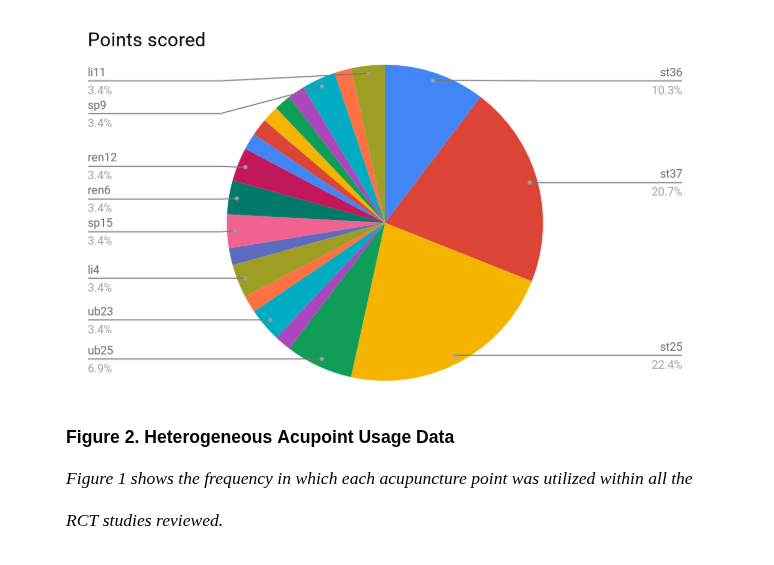
Figure 1 shows that that across all studies, ST36, ST37, and ST25 were the acupuncture points most often used to treat IBS. These points show the most consistent and significant improvements in the symptoms of bloat, gas, pain, Bristol Stool Scale, Anxiety and Depression scales, and QOL scales subjectively as well as the greatest measurable impact biologically based on immunohistochemistry assays, DAI scores, immunofluorescence, electron microscopy, Western blot, ELISA, Toluidine Blue Staining, and plasma sample analysis. However, it is unclear why these points were selected nor is it clear why these points are more functionally significant that other points. None of the studies discussed a biomedical rationale for point selection and none of the studies referred to a traditional theoretical framework that would support point selection. Application of moxibustion was discussed briefly as a thermal effect; however, there were no other references to biomechanics, herb properties, or even theoretical mechanisms of function aside from heat. Furthermore, the studies reviewed did not follow any consistent protocols for assessment, diagnosis, or treatment which made data comparison and evaluation difficult due to the heterogeneous nature.